From 24 September, Lisson presents an exhibition of drawings, paintings and sculpture by Carmen Herrera, spanning the final decade of the artist’s life. Curated by art historian Marie Perennès, the display frames Herrera’s late works not as epilogues, but as the vital culmination of an eighty-year enquiry into line, form and colour. Born in Havana in 1915, Herrera studied as an architect in the 1930s before moving to New York in 1939 and training at the Art Students League in the early 1940s. From 1948 to 1953, she lived in Paris, where she shifted from the lyrical abstraction of her early paintings towards the ‘pure’ hard-edge style that became her art’s defining attribute. A direct contemporary of New York Schoolers such as Barnett Newman and Jackson Pollock, Herrera was one of the great unsung exponents of geometric abstraction, resolutely pursuing a sequence of spatial, colouristic concerns over multiple decades, before finally achieving widespread recognition in the 2010s – while still at the height of her powers.
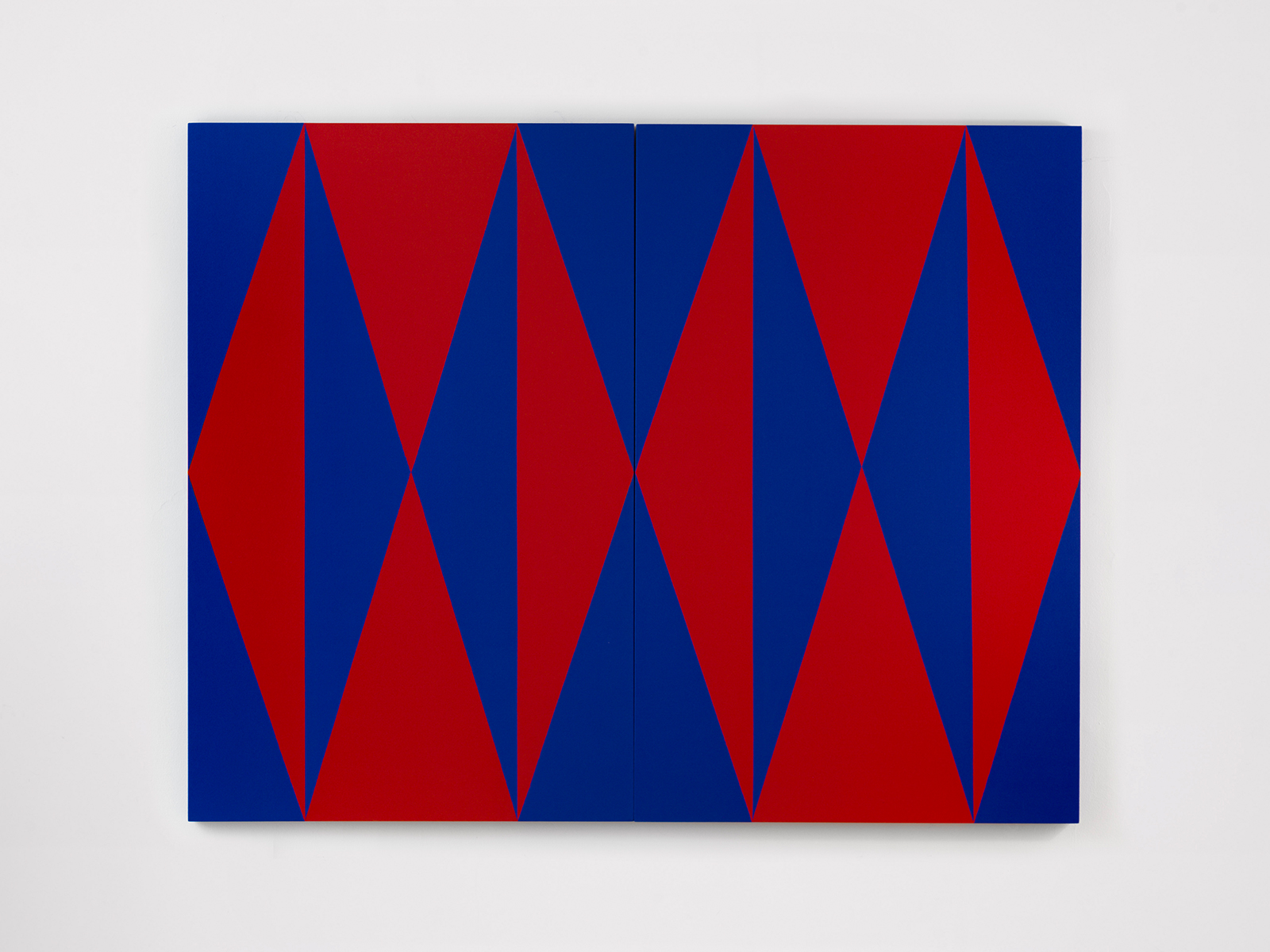
Across four galleries, the exhibition bears witness to the range and dynamism of Herrera’s art in her final twelve years. Paintings and drawings of diverse scales “pulse, shift and activate space like visual scores”, in Perennès’ words – their repetitions, variations and interruptions generating a near-musical rhythm. In the opening room are compositions that reflect the artist’s foundational and enduring interest in colour, distilled here into a variety of diagonal patterns. The two-part Untitled (2016) features elongated red and blue triangles in a serried, interlocked formation that alternately connotes and defies a sense of spatial depth. A pair of smaller studies in acrylic marker prefigure the final composition, their handmade appearance forming a marked counterpoint to the smooth, hard-edged finish of the painting.
Interviewed in 2020, Herrera observed that she had always been curious about “two colours reacting or dancing with each other”. The dual sense, in her preparatory works, of chance and calculation – of spontaneity imbued with a hard, architectural logic – recurs throughout much of her art. Precision of execution is offset, often, by a subtler sense of the incidental nature or covert playfulness of the given combination, introducing small disturbances into an otherwise rigorous order. “All colours are quite the same to my liking ... including black and white”, she once remarked. “But put two of them together in the context of minimal forms and divisions, with a straight line, and you have a unique sensation.”
Columbina (2013), with its alternation of black and orange triangles and central black rhombus, suggests a fragment of a gigantic harlequin pattern. The tension between the painting as an autonomous object, and its implied extension ad infinitum, is one that reverberates throughout Herrera’s art. Elsewhere in the first room, Herrera has skewed the balance of a composition by teasing the central shape into an elongated trapezium rather than a diamond-like square the painting on paper Untitled (2015) features such a shape in mid-blue against dazzling orange. It is an anomalous move of the kind that the art historian Robert Storr has termed an “off-beat solution”, rooted in the trial-and-error experiments of her initial sketches on graph paper. In Angulo (Orange) (2017–18), a work from Herrera’s Estructuras series, geometry leaves the plane of the painting to unfold in space.
Balancing the first gallery, the second space features a group of works in rectilinear patterns and saturated colours. Rectangles and squares congregate in grid-like arrangements, reflecting Herrera’s long investment in the histories of Modernist abstraction and colour field painting. And yet the appearance of regularity and logic is offset once more by a tendency towards the anomalous, the offbeat, the emotive: the grid itself seems conditional, subject to be teased apart – or entirely subsumed – by colour. In Escalera al Cielo (2017), orange rectangles rise in twin stacks against a uniform black; repetition becomes progression, the degrees of separation between the shapes appear both calculated and contingent. The ‘chance’ aspect of their arrangement is countered – amplified – by the cool precision of their hard-edged sections. The musical dimension of Herrera’s work, even at its most tautly controlled, harbours a crucial element of improvisation.
Herrera considered her early investigations into “space and line”, as an architectural student in 1930s Cuba, central to her later practice. The works in the third gallery are unified by linear motifs, and highlight the capacity for lines in Herrera’s art to become ‘shapes’ in their own right. Two-dimensional lines traverse, divide nd suspend space, hinting at – or even concretising into – three dimensional structures. Starting in the 1960s, Herrera conceptualised a series of sculptural objects in various materials, the Estructuras, several of which were realised in monumental form in New York’s City Hall Park in 2019-20.
The final space focuses on Herrera’s translations of her geometric language into black-and-white. Begun in 1950, her blackand-white paintings were not so much a series in their own right as a means of stepping back from her experiments in colour – of mirroring those experiments in an elemental form that she termed depuración (‘purification’). Figure and ground are interchangeable, as in her colour works: black on white might equally be white on black. A work such as Adios (2010), for example, is altogether ambivalent, its spliced triangles and rectangles seeming in the same moment to fold together and to open out. Reduced to this elemental vocabulary, the forms function almost like signs in an alphabet or notes in a score, their stark contrasts producing a sense of vibration and instability.
This exhibition at Lisson London precedes Herrera’s major retrospective at The Guggenheim Museum Bilbao, curated by Geaninne Gutiérrez-Guimarães, opening April 30 – October 24, 2027.