Anish Kapoor: ‘Especially in the art world, any sense of the radical has gone’ – Financial Times
9 June 2026
When Anish Kapoor was a teenager, he and his brother were sent abroad by their parents. They had grown up in Mumbai, in a Hindu-Jewish household. Now they lived on a kibbutz in the north of Israel. “We were like, 15, 16 years old, you know. Nothing. Kids,” he says. “And I had a terrible, terrible, I suppose, breakdown. It was horrible. It was really hard.”
One day, the boys’ mother came to visit. Kapoor’s aunt, who lived in Tel Aviv and “had a kind of predilection for the psychic”, told her: “Hilda, you have to go to India and you have to get some earth from a place that Anish loved. And put it under his bed.”
“So that’s what she did. She went to India, got some earth and put it under my bed. She was a cosmopolitan, practical, completely realistic human being, my mother. But she did this, because we do things for our children, don’t we?”
Today we’re in Kapoor’s sunlit studio in Camberwell, south London. The 72-year-old artist, who throughout our time together entertains me with opinions on the Buddha, Prussian blue, menstruation and Matisse in a voice that is deeply posh and fruity — he is good value — briefly chokes up. “Sorry. It’s always emotional,” he says.
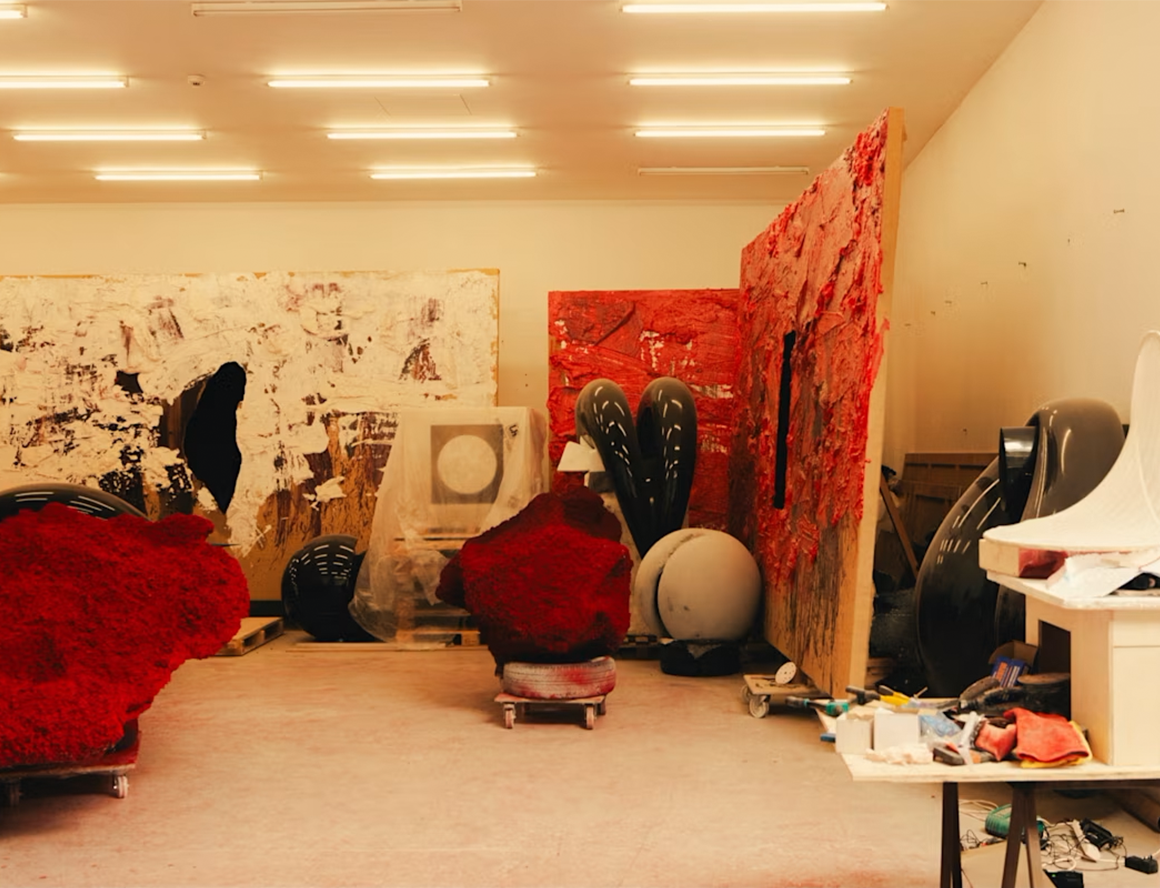
The memory is an unexpectedly poignant explanation for Kapoor’s taste for the theatrical — gleaming steel and blackest black sculptures that warp the viewer’s sense of space, macho blood-red installations that evoke ancient myths. Later this month, his exhibition at London’s Hayward Gallery, filled with such pieces, will struggle to contain a mysterious crimson mountain.
Kapoor ushers me into the first of several workrooms, where assistants dressed in white overalls are piecing together fragments of this vast, craggy landscape. “We’re trying to get it to glow,” he says. “Bit mad, but there you go.”
He is thinking of using a Hebrew title: “Ha Makom”. “It means place. But in the Kabbalah, place is also the name for God.”
An inverted mountain, “Mount Moriah at the Gate of the Ghetto” (2022), will flow down from the Hayward’s ceiling, its red and black-streaked peak floating inches from the floor. The topsy-turvy landscape was originally shown at the entrance to the 16th-century Palazzo Manfrin in Venice, acquired by Kapoor in 2018 (the Jewish ghetto is across the canal).
Moriah was where Abraham, according to biblical tradition, almost sacrificed his son Isaac. “That whole question, of the sacrificial moment of place, is terribly important to me,” Kapoor says. “That’s the real psychic job of the artist.”
Kapoor, his white hair swept past green acetate glasses, has a savant’s charm. Suddenly he’s talking about Jackson Pollock. “Pollock is making drip paintings, painting on the floor. In my view, paint is just a replacement for the real material: blood and semen. They’re very male, they’re very grrr . . . And then, he does the thing which is, at one level, so simple and, another level, so mysterious. What does he do? He takes it from the floor and puts it on the wall. Simplest thing there could be. And in so doing, performs an act of fundamental transformation.”
That “act of archaic alchemy” is what makes an artist. “If you see a good Pollock — and not all of them are,” he says, wagging his finger, “it is no longer a drip painting. It’s a cosmic diagram. He’s turned earth, blood and semen into sky.”
Read the full interview with En Liang Khong for the Financial Times here.
Image: Artworks in the studio © Jacob Lillis for Financial Times.