Oliver Lee Jackson
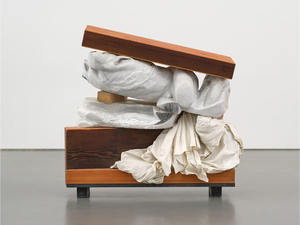
Oliver Lee Jackson is a painter, sculptor and printmaker whose creations open up spaces for contemplation and interpretation, as well as encounters with seen and unseen worlds. He has long engaged in freeing form and matter from the strictures and false oppositions between figuration and abstraction, preferring hybridity, ambiguity and improvisation with his materials over fixed meanings and didacticism.
Beginning with gridded compositions in the 1960s and then moving his large canvases to the floor in the 1970s in order to approach his work from multiple orientations, Jackson’s images remain based in the world and bound to human experience. “Every exchange we have, regardless of whether we call it spiritual or not,” says the artist, “is through the world, by the senses, absorbing things in things, exploiting things by things, always relationships with things.”
His chosen materials—stone, steel, wood, marble, fabric, paint—become the conduit for him to communicate feelings, moods and shared phenomena through the making of effects and images. The figure is a constant presence—sometimes overt, sometimes fragmentary and fugitive—in all of Jackson’s work, acting as both starting point and anchor for the marks, passages, moments and motives behind each composition. Even on a two-dimensional surface, the relative weights and volumes of brushstrokes, handprints and color expanses create fluctuating densities, depths and spatial possibilities. Demonstrative narratives or references to actual events are rare or fleeting in his work. An exception is found in his title for his 1960s–1970s series of paintings based on photographs of anti-Apartheid demonstrators caught in the Sharpeville Massacre of 1960 in Johannesburg, South Africa, whose gestures profoundly reflected interior states of being—in this case fleeing the terror of state-sponsored violence. Otherwise, Jackson cites influence from both African and European art traditions to feed his approach to working that suggests a timeless, bodily flow of life force, memory and atmosphere.
Oliver Lee Jackson was born in 1935, in St. Louis, Missouri and now lives and works in Oakland, California, USA. After attending the University of Iowa and advising the St. Louis collective of musicians, poets, dancers and artists known as the Black Artists Group (known as BAG) in the late 1960s, Jackson relocated to the West Coast to be a professor of art at the California State University, Sacramento, from 1971 until 2002, where he initially developed a curriculum for the Pan African Studies program. In addition to numerous collaborations with writers, musicians and dancers, Jackson has worked on large-scale commissions and held major solo presentations at the Saint Louis Art Museum, St. Louis, MO (2021); di Rosa Center for Contemporary Art, Napa, CA (2021); National Gallery of Art, Washington, DC (2019); Contemporary Art Museum, St. Louis, MO (2012); Harvard University, Cambridge MA (2002); Crocker Art Museum, Sacramento, CA (1993, 1984, 1977); Seattle Art Museum (1982) among others.

Oliver Lee Jackson
No. 1, 2016 (1.2.16), 2016
Oil paints, oil enamel on wood panel
241.3 x 182.9 cm
95 x 72 in
Framed: 246.4 x 188 cm
Framed: 97 x 74 in

Oliver Lee Jackson
Painting (12.78), 1978
Oil-based enamel on cotton canvas
271.8 x 207.6 cm
107 x 81 5/8 in

Oliver Lee Jackson
Painting (8.29.98),1998
Water-based paints on gessoed linen
243.8 x 213.4 cm
96 x 84 in

Oliver Lee Jackson
Alchemy Series VI, 1976
Oil enamels, aluminum paint on cotton canvas
273.1 x 274.3 cm
107 1/2 x 108 in

Oliver Lee Jackson
Monotype VIII, 2006
Printer inks on paper
76.2 x 111.8 cm
30 x 44 in
Framed: 86.4 x 123.2 x 5.1 cm
Framed: 34 x 48 1/2 x 2 in

Oliver Lee Jackson
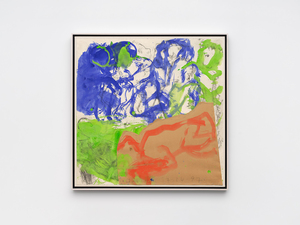
Untitled Painting (1.30.24), 2024
Artist oil paints, spray enamel, chalks on plywood panel
246.4 x 187.9 x 5 cm
97 x 74 x 2 in

Oliver Lee Jackson
Installation image: Oliver Lee Jackson, Saint Louis Art Museum, Missouri, USA, July 16, 2021 – February 20, 2022
Image courtesy of Saint Louis Art Museum.

Oliver Lee Jackson
Installation image: Oliver Lee Jackson, Saint Louis Art Museum, Missouri, USA, July 16, 2021 – February 20, 2022
Image courtesy of Saint Louis Art Museum.

Oliver Lee Jackson
Installation image: Oliver Lee Jackson: Any Eyes, di Rosa Center for Contemporary Art, Napa, CA, USA, November 19, 2021- February 20, 2022
Photos by M. Lee Fatherree.

Oliver Lee Jackson
Installation image: Oliver Lee Jackson: Recent Paintings, National Gallery of Art, Washington DC, USA, April 14 – September 15, 2019
Photos by Rob Shelley, Courtesy National Gallery of Art.

Oliver Lee Jackson
Installation image: Oliver Lee Jackson: Recent Paintings, National Gallery of Art, Washington DC, USA, April 14 – September 15, 2019
Photos by Rob Shelley, Courtesy National Gallery of Art.